
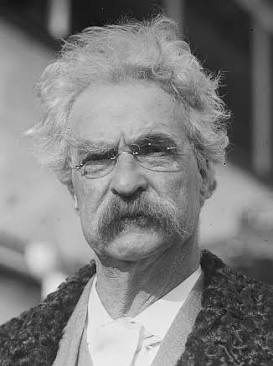
By Benson Judge| Published: July 13, 2026
REDDING, CONNECTICUT — Mark Twain, born Samuel Langhorne Clemens, one of America’s most celebrated authors, humorists, and social critics, died on April 21, 1910, at his Stormfield estate in Redding, Connecticut. He was 74.
Twain’s passing marked the end of one of the most influential literary careers in American history. Revered by generations of readers and scholars as “the father of American literature,” he transformed storytelling through wit, satire, realism, and an unmistakable voice that captured both the promise and contradictions of the United States.
His death also fulfilled one of the most remarkable anecdotes in literary history. Born shortly after Halley’s Comet appeared in 1835, Twain famously remarked in 1909 that he expected to “go out with it.” The comet returned in April 1910, and Twain died just one day after its closest approach to Earth—an extraordinary coincidence that has become inseparable from his enduring legend.
A Literary Giant Who Defined American Storytelling
Born on November 30, 1835, in Florida, Missouri, Samuel Clemens grew up along the Mississippi River, experiences that later inspired some of the most enduring works in American literature.
Writing under the pen name Mark Twain, he produced classics including:
- The Adventures of Tom Sawyer (1876)
- Adventures of Huckleberry Finn (1884)
- A Connecticut Yankee in King Arthur’s Court (1889)
- The Prince and the Pauper (1881)
- Life on the Mississippi (1883)
His novels blended humor with sharp social commentary, addressing issues including racism, slavery, politics, religion, education, and human nature.
Renowned author William Faulkner would later describe Twain as “the father of American literature,” a characterization that remains widely accepted by literary historians.
His Final Hours
Contemporary newspaper reports documented Twain’s final day in remarkable detail.
According to The New York Times’ obituary published in April 1910, Twain died at approximately 6:22 p.m. at Stormfield after months of declining health. The newspaper noted that a copy of Thomas Carlyle’s The French Revolution rested beside his bed during his final hours—a poignant image for a writer whose lifelong passion for history, politics, and literature shaped his work.
Following his death, tributes poured in from political leaders, fellow authors, publishers, and readers across the United States and abroad, reflecting the extraordinary cultural influence he had achieved during his lifetime.
The Halley’s Comet Prediction
One of the most enduring stories surrounding Twain’s death involves Halley’s Comet.
Twain was born shortly after the comet’s appearance in 1835 and reportedly said in 1909:
“I came in with Halley’s Comet in 1835. It is coming again next year, and I expect to go out with it.”
The prediction proved remarkably accurate.
Halley’s Comet reached perihelion on April 20, 1910, and Twain died the following day, a coincidence that has fascinated historians and readers for more than a century.
Mark Twain’s Fascination With Obituaries
Ironically, Twain was fascinated by obituaries long before his own appeared in newspapers worldwide.
In 1902, he wrote and humorously revised several mock self-obituaries for publication in Harper’s Weekly, satirizing both celebrity culture and commercial interests. The pieces demonstrated his characteristic wit while revealing an unusual willingness to confront mortality with humor rather than fear.
This fascination also helps explain why so many quotations about death and obituaries have later become incorrectly associated with him.
Setting the Record Straight: A Famous Misquote
Among the countless quotations attributed to Mark Twain, one of the most widespread is:
“I’ve never wished a man dead, but I have read some obituaries with great pleasure.”
Despite its popularity, there is no credible historical evidence that Twain ever wrote or said these words.
Historical research, including a review by Snopes, attributes the remark instead to renowned American attorney Clarence Darrow, who reportedly used a similar expression in 1922, more than a decade after Twain’s death.
The quote remains one of the most persistent examples of false attribution involving Twain—a reminder that even legendary authors are not immune to internet-era misinformation.
Burial and Memorial
Following funeral services, Mark Twain was laid to rest on April 24, 1910, in the Langdon family plot at Woodlawn Cemetery in Elmira, New York.
He was buried beside his beloved wife, Olivia Langdon Clemens, with whom he shared more than three decades of marriage.
Today, his gravesite remains a destination for literary enthusiasts from around the world, while his Hartford, Connecticut home and other historic landmarks continue to preserve his extraordinary legacy.
Essential Wisdom: The Authentic Quotes of Mark Twain
While his obituary quote may be a myth, Twain left behind a verified treasury of razor-sharp observations on truth, humanity, and the ideal life.
On Truth and Integrity
-
On Memory: “If you tell the truth, you don’t have to remember anything.”
-
On Discretion: “Never tell the truth to people who are not worthy of it.”
-
On Deception: “A lie can travel half way around the world while the truth is putting on its shoes.”
On Intellectual Life and Growth
-
On Contentment: “Good friends, good books, and a sleepy conscience: this is the ideal life.”
-
On Literacy: “The man who does not read has no advantage over the man who cannot read.”
-
On Bookrooms: “In a good bookroom you feel in some mysterious way that you are absorbing the wisdom contained in all the books through your skin, without even opening them.”
-
On Aging: “When I was a boy of 14, my father was so ignorant I could hardly stand to have the old man around. But when I got to be 21, I was astonished at how much the old man had learned in seven years.”
On Non-Conformity and Ambition
-
On the Majority: “Whenever you find yourself on the side of the majority, it is time to reform (or pause and reflect).”
-
On Ambition: “Keep away from people who try to belittle your ambitions. Small people always do that, but the really great make you feel that you, too, can become great.”
-
On Entitlement: “Don’t go around saying the world owes you a living. The world owes you nothing. It was here first.”
-
On Perspective: “Don’t part with your illusions. When they are gone you may still exist, but you have ceased to live.”
-
On Society: “What would men be without women? Scarce, sir…mighty scarce.”