
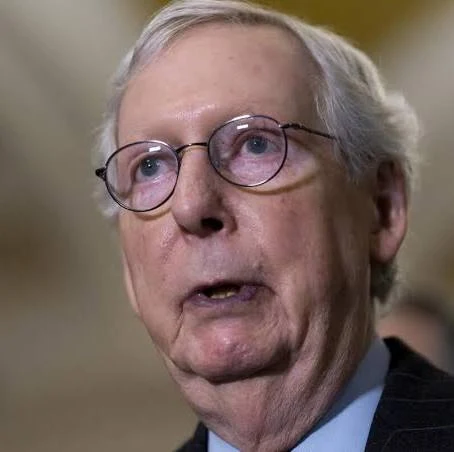
A sharply critical newspaper column examining the life and political legacy of Kentucky Senator Mitch McConnell has attracted national attention after being described as a “pre-obituary.”
The column was written for the Louisville-based Courier Journal by veteran Kentucky political journalist Joseph Gerth. It was not an official obituary or announcement of McConnell’s death.
Instead, the commentary assessed McConnell’s decades-long political career while the senator remains alive, amid continuing public questions about his health and prolonged absence from public view.
That distinction is essential.
As of July 23, 2026, no reliable government authority, family representative or major news organization has announced that Mitch McConnell has died. Claims circulating online about his death or medical condition should therefore not be presented as established facts.
What Did the Courier Journal Publish?
The Courier Journal published a political opinion column reflecting on how McConnell may eventually be remembered.
Reports about the column say Gerth openly framed it as a “pre-obituary”—a retrospective assessment written before the subject’s death. The columnist credited McConnell with some achievements while delivering a strongly negative judgment on much of his later political legacy.
The article reportedly examined subjects including:
- McConnell’s influence on the federal judiciary and United States Supreme Court
- His handling of Supreme Court nominations under different presidents
- His relationship with President Donald Trump
- His response to the January 6, 2021, attack on the United States Capitol
- His earlier involvement with civil-rights causes
- Federal funding and development projects connected with Kentucky
The column represents Gerth’s analysis and opinion. It should not be confused with straight news reporting or a family-approved account of McConnell’s life.
Is Mitch McConnell Dead?
There is no authoritative confirmation that Mitch McConnell is dead.
Rumors about his condition intensified after reports that he had been hospitalized and remained away from public appearances. McConnell’s office reportedly issued limited information, creating an environment in which unsupported claims spread quickly online.
At least one advocacy organization reportedly posted and later removed a message referring to McConnell’s supposed death. That incident did not constitute official confirmation and illustrates why social-media posts should not be treated as reliable death notices.
A legitimate death announcement involving a sitting United States senator would normally be confirmed through sources such as:
- The senator’s family or official office
- The United States Senate
- Government authorities
- Major national news agencies citing named sources
- An identified funeral home or authorized representative
Until such confirmation exists, headlines stating “Mitch McConnell dies” or “Mitch McConnell obituary” would be inaccurate.
Why Was the Column Called a “Pre-Obituary”?
A pre-obituary is a retrospective article written about a living person as though reviewing the major themes of a completed career.
News organizations routinely prepare unpublished advance obituaries for prominent people so that accurate reports are available when a death is officially confirmed. However, those drafts are usually kept private.
The Courier Journal column was different because it was published openly as political commentary.
Gerth reportedly explained that he wanted to offer a candid assessment of McConnell’s legacy while the senator was alive rather than face criticism for expressing harsh judgments immediately after his eventual death.
The approach has generated debate over fairness, tone and whether such a retrospective should be published while serious questions remain about the subject’s health.
Who Is Mitch McConnell?
Addison Mitchell “Mitch” McConnell Jr. is a longtime Republican senator from Kentucky and one of the most influential congressional figures of the modern era.
He served for many years as the Republican leader in the Senate, including periods as Senate majority leader and minority leader.
His political legacy is closely connected with judicial confirmations, Senate procedure, campaign finance, Republican Party strategy and his approach to presidential power.
Supporters have praised him as an effective strategist who helped advance conservative judicial and legislative priorities.
Critics have accused him of intensifying political polarization, applying inconsistent standards to judicial nominations and prioritizing partisan power over institutional norms.
A responsible legacy article should acknowledge that both perspectives exist rather than presenting political opinion as neutral historical fact.
McConnell’s Influence on the Supreme Court
One of the most consequential elements of McConnell’s Senate career was his role in reshaping the federal judiciary.
In 2016, while serving as Senate majority leader, McConnell refused to advance President Barack Obama’s Supreme Court nominee, Merrick Garland, arguing that voters should influence the choice through the approaching presidential election.
In 2020, however, the Republican-led Senate confirmed President Donald Trump’s nominee Amy Coney Barrett shortly before another presidential election.
Critics cite the contrast as evidence of partisan inconsistency. Supporters argue that the Senate majority was exercising its constitutional authority in both cases.
The resulting confirmations helped create a durable conservative majority on the Supreme Court, making judicial appointments a central part of McConnell’s political legacy.
Mitch McConnell and Donald Trump
McConnell’s relationship with Donald Trump has combined political cooperation, public criticism and repeated tension.
As Republican leader, McConnell helped advance major elements of Trump’s first-term agenda, particularly judicial appointments and tax legislation.
After the January 6 attack, McConnell publicly blamed Trump for contributing to the events surrounding the Capitol violence, although he voted to acquit Trump during the Senate impeachment trial.
He later supported Trump’s return as the Republican presidential nominee despite their personal and political conflicts.
The Courier Journal commentary reportedly treated that decision as an important part of its criticism of McConnell’s legacy.
What Is the Safeguard American Voter Eligibility Act?
The Safeguard American Voter Eligibility Act, commonly called the SAVE Act, is federal legislation focused on requiring documentary proof of United States citizenship when registering to vote in federal elections.
Supporters argue that the proposal would strengthen confidence in election integrity and help prevent noncitizens from being added to voter rolls.
Opponents argue that existing law already prohibits noncitizens from voting in federal elections and that strict document requirements could prevent eligible citizens from registering, particularly those who lack easy access to passports, birth certificates or updated identity records.
The legislation and later related proposals became major subjects of debate ahead of the 2026 midterm elections.
McConnell’s Connection to the SAVE Act
In early 2026, Republican members of the House publicly urged McConnell, in his committee leadership role, to advance the SAVE Act through the Senate Rules and Administration Committee.
Their statements accused the Senate of delaying action and called on McConnell to schedule committee consideration before the midterm elections.
The legislation later encountered resistance in the Senate. Reporting and legislative-analysis organizations said Republican senators were not united on the strategy required to advance it, while Democratic opposition created an additional procedural barrier.
The bill’s status and McConnell’s role should be presented separately from reporting about his health. Combining them without explanation could incorrectly suggest that the legislation was connected to rumors about his death.
Health Questions and the Public’s Right to Accurate Information
McConnell’s extended absence has produced legitimate public-interest questions.
A sitting senator holds an office of national importance, and constituents reasonably expect information about whether their representative can perform official responsibilities.
However, the public interest in transparency does not justify publishing unsupported medical claims.
Reports have raised concerns about how little information McConnell’s staff provided following his reported hospitalization. Critics have argued that elected officials and their offices should offer clearer disclosure when illness prevents prolonged participation in Senate business.
Nevertheless, limited information is not proof of death, incapacity or any particular diagnosis.
Responsible reporting should state what is known, identify the source and explain what remains unconfirmed.
Why False Obituary Reports Are Harmful
Publishing an obituary before a person’s death has been verified can cause serious harm.
It can distress family members, mislead readers, amplify rumors and permanently undermine a publication’s credibility.
The risk is even greater when the subject is a major political figure because false reports can affect public confidence, financial markets, government processes and political succession discussions.
Search visibility should never be pursued by presenting rumor as fact.
A reliable publication may discuss a death rumor, but the headline and opening paragraph must immediately make clear that the claim is unconfirmed or false.
Editorial Assessment
The Courier Journal column should be described accurately as a published political commentary or pre-obituary, not as Mitch McConnell’s official obituary.
Its value lies in stimulating discussion about how a powerful political figure should be judged while history is still unfolding.
Its controversial framing is also part of the story.
Readers may agree or disagree with Gerth’s conclusions, but they should be given enough context to distinguish among:
- Confirmed biographical facts
- Political analysis
- Medical uncertainty
- Unsupported death rumors
- Official legislative developments
Keeping those categories separate is essential to trustworthy journalism.
Conclusion
The controversy surrounding the Courier Journal column reflects more than public curiosity about Mitch McConnell’s health.
It is also a debate about political legacy, media ethics, government transparency and the boundary between commentary and obituary reporting.
Mitch McConnell has shaped the United States Senate, the federal judiciary and Republican politics for decades. Any eventual assessment of his career will include accomplishments praised by supporters and decisions strongly condemned by critics.
But an official obituary can only be published after his death has been reliably confirmed.
Until then, the accurate description is straightforward:
The Courier Journal published a provocative pre-obituary assessing Mitch McConnell’s political legacy—not a verified notice of his death.